Human Ambivalence Toward AI — IBM's Unhappy Shareholders and Clients
Last time we mentioned that there was a group of scientists who dreamed of artificial intelligence (AI), even when the conditions were not quite ripe in reality, they still held a summer camp—I mean, a research conference called “Artificial Intelligence” and worked hard at discussing, planning, creating goals, and pursuing their ideals. It’s a lovely story that makes the readers teary! However, as AI technologies were being developed, people with different presumptions and perspectives in understanding this area had completely different responses.
Scientists Who Want to Rely on AI to Do Math and Play Games
Nathaniel Rochester, one of the sponsors of the Dartmouth Conference, designed the IBM 701 computer with executable program instructions a few years prior. He was an industry person and a researcher, in addition to supplying hardware equipment for major research units, led an interdisciplinary research department at IBM in pattern recognition, information theory, and switching circuit theory. He also combined the neural network theory of two other Dartmouth Conference organizers, Marvin Minsky and John McCarthy, to run simulations on an IBM 704 and published a paper about it. [1] However, Rochester's main interest was in making computers calculate mathematical problems. [2]
By around 1957, Allen Newell and Herbert A. Simon, who invented Information Processing Language (IPL) at RAND, had already completed the Logic Theorist (commonly recognized as the first AI program) and were ready to start implementing the General Problem Solver. Minsky wrote a small simulation program to prove a simple high school geometry theorem. On the one hand, Rochester was stimulated and inspired by these competitors to develop a geometric problem solver that could be executed on an IBM computer. At the same time, he felt that it was necessary to invent a new language that can define operators like IPL and is computationally friendly like FORTRAN and had the advantages of both. It just so happened that IBM had a new physics Ph.D., Herbert Gelernter, who was extremely enthusiastic about research and development, and Rochester handed over the task to him. A few years later, Gelernter overcame many difficulties and completed the Geometry Theorem Prover/Machine[3], as well as the language used to control this machine, the Fortran List Processing Language (FLPL)[4] The user must first input the given conditions for the machine to find the solution for the proof.
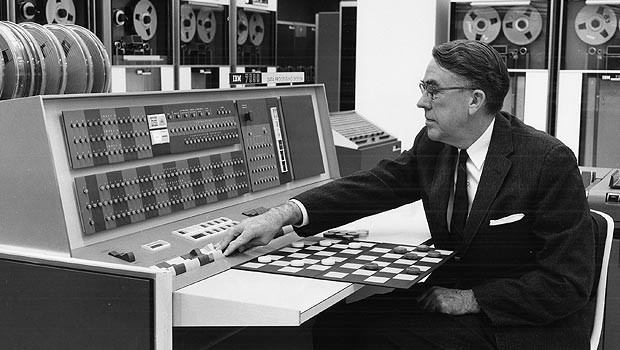
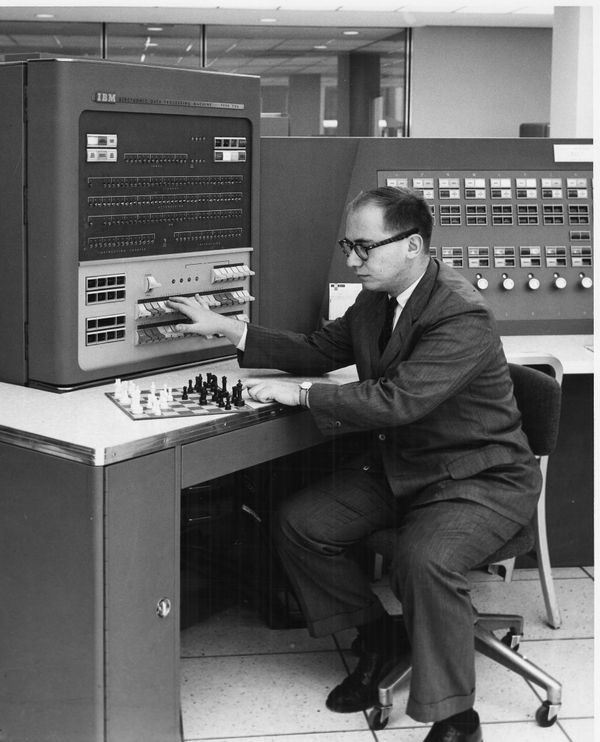
Everything looked great, the computer could do everything. Rochester also managed Arthur Samuel’s AI checkers project and Alex Bernstein’s AI chess project. These AI games all used IBM 704 machines and the trial-and-error strategies that they wrote into the programs to make the computer learn these specific board games. To this day, we can still find on the Internet some historical images and videos of Samuel and Bernstein playing against computers.
![]() |
![]() |
Figure 1. Left: Samuel and AI play checkers[5]; right: Bernstein and AI play chess. [6]
Figure 2. A video of Bernstein and AI playing chess. [7]
These projects were eye-catching very much. Once they were disclosed in the New York Times, Scientific American, and other media, they immediately caused widespread impact and discussion in society. Issues were raised, for example, “What is the current level of chess skills of these AIs?” “When will they be able to enter professional game arenas?” “When will humans be defeated?” (Wait, I seem to have heard similar opinions during the AlphaGo battle...) In any case, Samuel, Bernstein, and even Gelernter who created the Geometry Theorem Prover became very famous.
Unhappy Shareholders and Clients
Many books related to the history of AI have mentioned this, but they are also quite cryptic about it. In her book, “Machines Who Think,” Pamela McCorduck described the challenge faced by IBM company president Thomas Watson Jr.
“But T. J. Watson, the president of IBM, was not amused. IBM’s original, or at least official, justification for allowing Bernstein to use the first 704 for nothing more serious than game playing had been the hope that if he were successful, it would show the world—in particular, businesspeople—that computers could be used to solve problems even as difficult as ones that came up in business. But IBM’s stockholders had challenged Watson at the last meeting, wanting an explanation for the money being wasted on playing games .”
“[S]ales executives at IBM began to grow nervous lest the very machines they were trying to sell prove so psychologically threatening that customers would refuse to buy them. Thus they made a deliberate decision to defuse the potency of such programs by conducting a hard-sell campaign picturing the computer as nothing more than a quick moron. Countess Lovelace’s dictum, that the machine can do nothing more than we tell it to do…became a popular idea, a sort of slogan of the backlash…”[8]
As a result, Watson had had enough[9], the product line of computers was developed in the direction of faster computing, and the AI projects were suspended. Bernstein eventually became a psychiatrist; Gelernter returned to be physicist; Samuel went to Europe to join IBM competitors who were interested in his checkers project. As for Rochester, there seems to be no clear narrative about him concerning the discontinuation of the AI projects. By other references (such as his published works), he remained at IBM to develop hardware-related technologies.
This was not just a one-off event. In the late 1960s, there were two extreme oppositions to the investment and development of AI technology:
- AI is so smart and scary. My job will be replaced at any time (AI games, machine translation...)
- The current hardware cannot make AI perfect (Minsky's “Perceptrons” controversy[10])
As a result, the incidents and pressure gradually piled up and formed a period of stagnation in the development of AI technology for nearly a decade.
(To be continued…if there is a next episode...)
Reference:
[1]N. Rochester, J. Holland, L. Haibt and W. Duda, "Tests on a cell assembly theory of the action of the brain, using a large digital computer," in IRE Transactions on Information Theory, vol. 2, no. 3, pp. 80-93, September 1956, doi: 10.1109/TIT.1956.1056810.
[2] D. Crevier 1993, “… Intrigued, Rochester hoped that Minsky and McCarthy’s approach might help computers exhibit originality in problem solving, which was his main interest. …”, in AI: The Tumultuous Search for Artificial Intelligence, p.40. New York, NY: BasicBooks. ISBN 0-465-02997-3.
[3] H. L. Gelernter and N. Rochester, "Intelligent Behavior in Problem-Solving Machines," in IBM Journal of Research and Development, vol. 2, no. 4, pp. 336-345, Oct. 1958, doi: 10.1147/rd.24.0336.
[4] Gelernter, H., J. R. Hansen, and Carl L. Gerberich. "A FORTRAN-compiled list-processing language." Journal of the ACM (JACM) 7.2 (1960): 87-101.
[8] P. McCorduck, “Machine Who Think”, p.187.
[9] D. Crevier 1993, in AI: The Tumultuous Search for Artificial Intelligence, p.58. New York, NY: BasicBooks. ISBN 0-465-02997-3.
[10] M. Minsky, and S. Papert. "Perceptrons." (1969).